What is inner transition coaching, and how is it different from life coaching or therapy?
Inner transition coaching is a form of coaching for people whose lives look stable on the outside while something inside them is shifting. Instead of setting external goals like a promotion or a fitness target, it works with awareness, emotions, self-trust, and intuition, so you can hear what the shift is asking of you and respond to it at your own pace.
That is the short answer. The longer one starts with a familiar scene.
The quiet shift no one else can see
You know the feeling. Your work is fine, your relationships are fine, your calendar is full of reasonable things. When someone asks how you are, "good" is an honest answer. And still, somewhere underneath the functioning, a quiet voice keeps saying that this chapter is ending.
Most coaching models assume you already know what you want and simply need help getting there faster. Therapy often assumes something needs healing. Inner transition coaching starts from a third place: nothing is broken, and nothing is missing, yet something is moving, and you want company while you figure out what.
What inner transition coaching involves
In my practice at Cosmic Pyjamas, inner transition work follows a gentle arc: awareness, then emotions, then self-trust, then intuition. This is a rhythm rather than a rigid method, and clients move through it in their own order and at their own pace.
Awareness comes first because most women in transition have spent years attending to everyone else's needs. We slow down enough to notice what is happening inside: which thoughts repeat, where the body tightens, what the days feel like rather than what they look like.
Emotions come next. A transition stirs up feelings that rarely fit into a busy weekday, such as grief for a version of yourself that is ending or restlessness with no obvious cause. In coaching, these feelings have room to exist and be understood, often through the cognitive triangle, which maps how thoughts, feelings, and actions feed into each other in a loop.
Self-trust grows from there. When you can observe your thoughts and allow your feelings, your own judgment starts to sound trustworthy again. Many clients arrive outsourcing decisions to podcasts, partners, and productivity systems. They leave decisions to be made from the inside.
Intuition is the final layer. Once the noise settles, the quiet voice that started it all becomes audible. Intuition here means concrete inner knowing that leads to small, doable next steps, tested in real life rather than kept as a vague feeling.
Sessions happen online, in Finnish or English, and the pace stays humane. Nervous-system safety comes before speed, always.
Inner transition coaching vs. life coaching vs. therapy
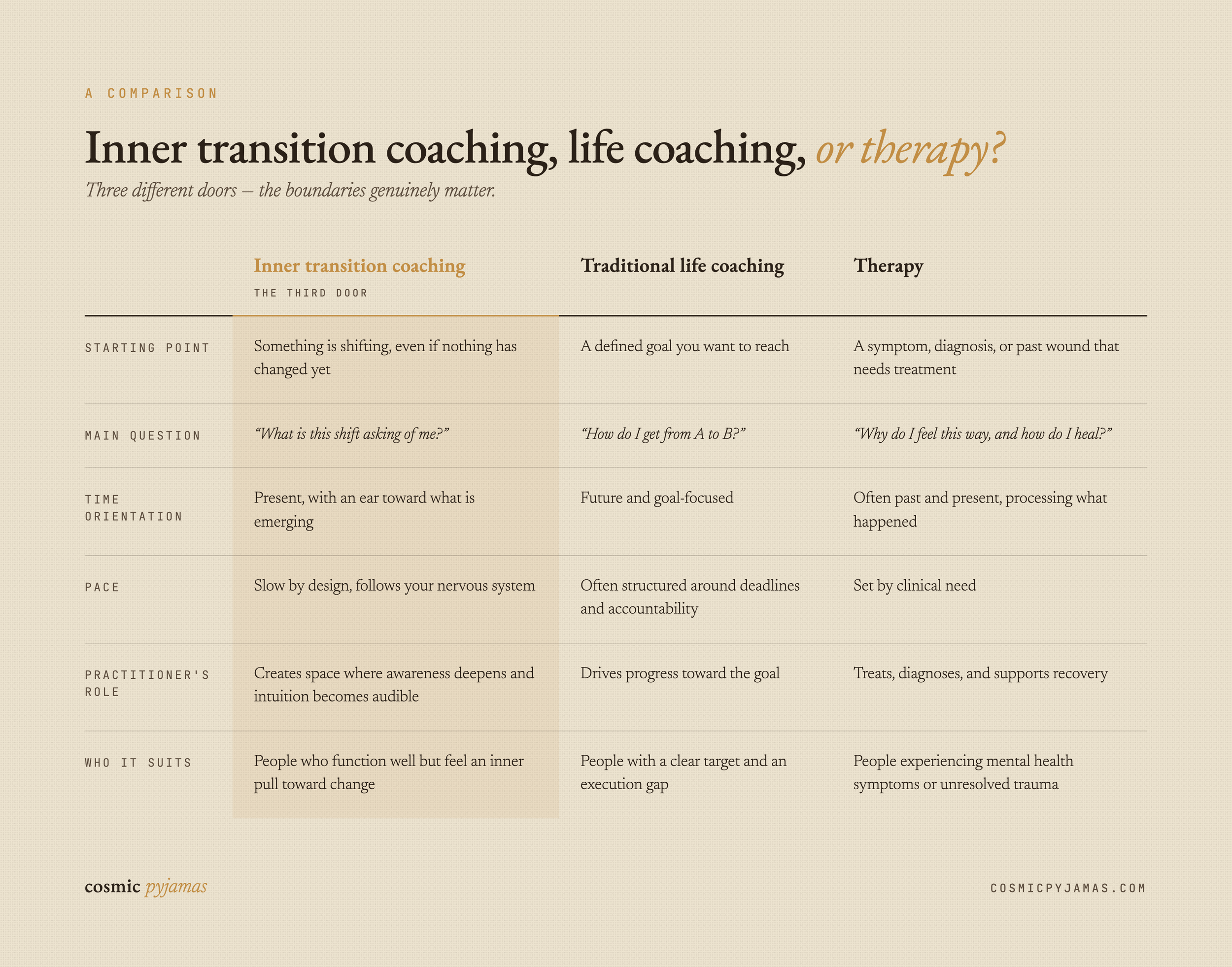
A comparison helps, because the boundaries genuinely matter.
How it differs from traditional life coaching
Classic life coaching tends to be goal-first. You name the outcome, the coach helps you build the plan, and success is measured by whether you reached it. That model works beautifully when you know what you want.
Inner transition coaching serves the earlier, murkier phase, the one where you can feel that something is over before you can say what comes next. Progress here is measured in clarity, confidence, and calm. A client might end our work together with a career change, or she might end it in the same job with a completely different relationship to herself. Both count as successes because the outcome grows from her own knowing rather than from a template.
How it differs from therapy
This distinction deserves care. Therapy is healthcare. A licensed therapist can diagnose and treat conditions like depression, anxiety disorders, and trauma, and if you are struggling with your mental health, therapy is the right door and coaching is a poor substitute.
Coaching assumes a baseline of wellbeing. My clients are, by any clinical measure, doing fine. What they need is space, honest reflection, and a companion for the in-between, which is exactly what coaching offers and therapy is rarely designed for. The two can also coexist: some clients see a therapist for one thing and a coach for another, and the roles stay clear.
If you are ever unsure which you need, ask yourself whether you are trying to recover or trying to listen. Recovery belongs to therapy. Listening is where coaching begins.
Who inner transition coaching is for
The women I work with share a recognizable profile. They are self-aware, thoughtful, and curious. They read the books; they understand themselves reasonably well, and self-knowledge alone is no longer enough. They want structure and soul in the same room, without swinging between spreadsheet-driven optimization and pure vibes.
Common situations include approaching or passing a milestone birthday and feeling the ground tilt, succeeding in a career that has quietly stopped fitting, emerging from years of caregiving and wondering who is left underneath, or simply sensing that the next chapter has started writing itself without permission.
What a coaching relationship looks like in practice
At Cosmic Pyjamas, coaching happens in one-to-one online sessions, in Finnish or English. Each session opens and closes with a small intentional moment, and the work in between blends reflective conversation with practical tools:
awareness practices
emotion work grounded in the cognitive triangle
exercises that strengthen the connection between inner knowing and everyday choices.
Seasonal rhythms give the work a natural shape, because inner transitions, like the year itself, move through phases of ending, resting, stirring, and beginning.
Between sessions, clients receive reflection prompts and a gentle written summary, so the work keeps breathing in ordinary life instead of living only in the calendar slot.
Frequently asked questions
Is inner transition coaching a substitute for therapy?
No. Coaching supports well-functioning people through change. Therapy treats mental health conditions. If you are experiencing symptoms of depression, anxiety, or trauma, a licensed therapist is the right professional, and a responsible coach will tell you so directly.
How long does inner transition coaching take?
Most clients work with me across several sessions over two to four months. Transitions have their own tempo, and the coaching honors that instead of forcing a timeline.
Do I need to know what I want before starting?
No, and this is precisely the point. Inner transition coaching exists for the phase before clarity. Arriving with only a vague sense that something is shifting is a perfectly complete starting point.
Is this the same as spiritual coaching?
The work stays grounded in recognized coaching tools and psychology. Seasonal and nature-based framing gives sessions atmosphere and rhythm, and every practice remains concrete, gentle, and testable in your actual life.
Jenna Lamberg is a certified life coach (LCAF) based in Espoo, Finland. Through Cosmic Pyjamas she coaches women through inner transitions, online, in Finnish and English.
Last updated July 2026